How to choose the right wood-burning stove for you and your living room
There is no such thing as a wood-burning stove that suits everyone. Which type and model is best for you depends on your personal preferences, needs, style, the layout of your home and other factors that are useful to know about if you are looking for a solution that suits you and your living room perfectly. That is why we are happy to offer a little insight into what you should consider when choosing a new wood-burning stove – because it gives you the best possible basis for getting the most out of the crackling fire that creates both cosiness and warmth.
The wood-burning stove as a natural gathering point
For many people, the wood-burning stove is no longer just a practical way of heating the house. It is also something that can bring the household together around something organic, cosy and aesthetically pleasing – just as fire has done for people for thousands of years. Today, however, there are quite a few different ways of bringing the magical atmosphere, sounds and warmth of a fire into your living room. It might be a wood-burning stove, a pellet stove or an outdoor model that you can place on your terrace or in other outdoor areas.
On top of this, you need to assess heat output, safety, size and style, all of which must be weighed up against the layout of your home and the way you want to use the fire. If the stove is simply there to create atmosphere without giving off too much heat, that is one thing – if it is to serve as a heat source, that is quite another.
The stove's output vs. the square metres of your living room
It is no coincidence that we begin with output. Technically speaking, the relationship between the stove's output and the size of the room is the most important consideration when choosing a wood-burning stove. If, for example, you buy a stove that is too large, you will have to keep the fire burning quite low all the time.
That is not very efficient – and it also contributes to a build-up of soot. A stove that is too small, on the other hand, cannot heat the room sufficiently, which can be a problem during the cold winter months.
If you choose a modern wood-burning stove from HETA, the data sheet for the model in question will always state how many square metres the stove is suitable for. As a rule of thumb, pellet stoves make better use of heat than traditional wood-burning stoves, because the type of fuel and the design of the stove give a more even fire.

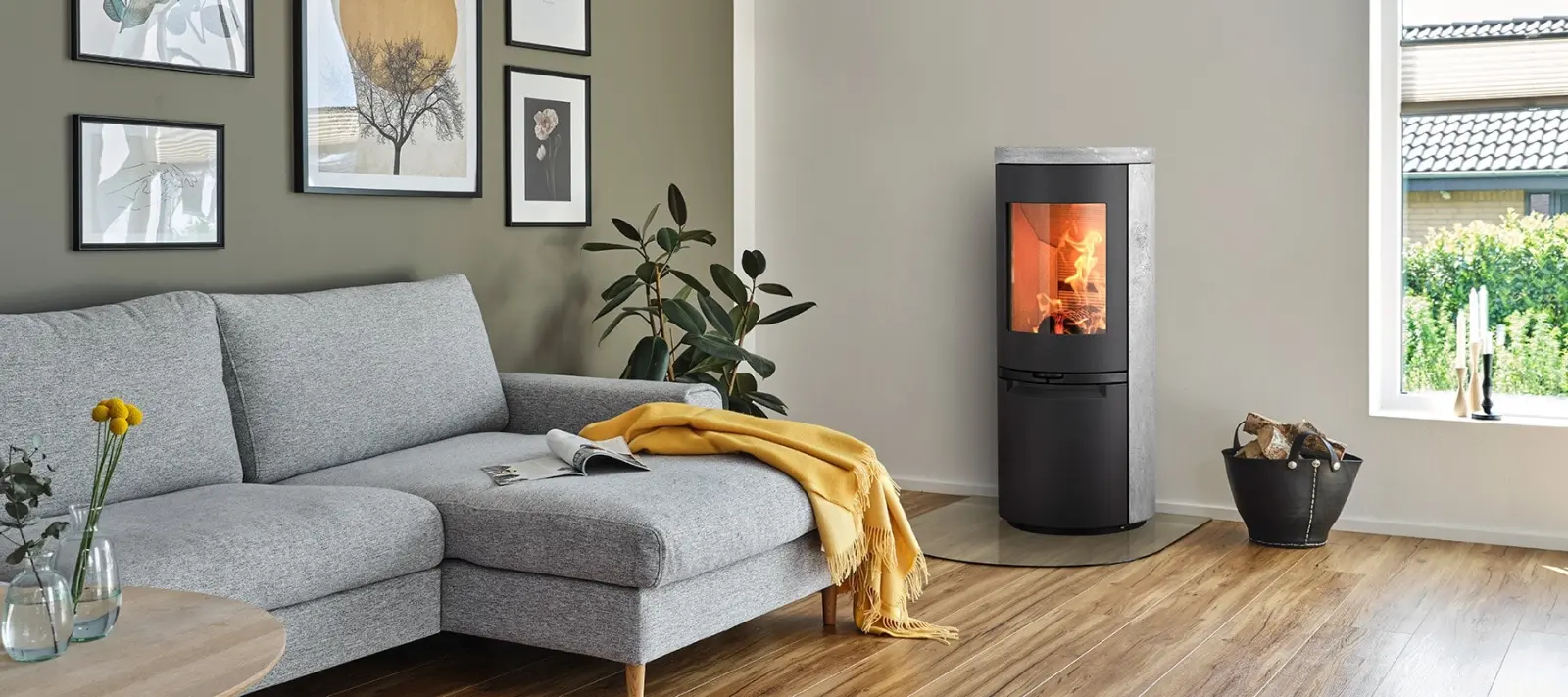
Heta Scan-Line 8 with side glass, Scan-Line 8 cast floor plate, log basket and fireplace set
Don't forget accessories and installation
In addition to the stove's heating function, it is also important to consider the architecture of the room and the overall purpose of installing a wood-burning stove in the first place. A slim, freestanding model often works best in a smaller room, while a larger stove with glass panels usually works better in more open surroundings, where the installation can be a natural focal point.
Many people also make the mistake of not taking into account all the accessories that any wood-burning stove requires. For example, is there a suitable chimney, or will one have to be built? Is it easy to store firewood at a comfortable distance from the stove without it looking messy?
When everything has been carefully thought through in advance and works well together, you are set up for lovely moments by the fire and all the practical rituals of lighting and tending it. If it has been sorted out in a rather haphazard way, there is a greater risk that the work becomes more of a chore than something you associate with cosiness and tradition.
Safety must always be a priority
When you are dealing with fire, there is always an important safety need to consider. However, different types of stove have different requirements. An ordinary wood-burning stove must, as a minimum, have an adequate chimney and stand on a surface that can withstand high temperatures and embers. In addition, the stove must of course not be placed near anything that could catch fire.
Pellet stoves are generally safer than wood-burning stoves. Again, this is down to the more controlled combustion – and the same applies to gas stoves, which must be fitted by certified installers. In all cases, we recommend having a carbon monoxide alarm and a fire alarm in the living room near the stove, so that you can react quickly if an accident should happen.
For outdoor stoves, the surface should also be fireproof and stable. Make sure the stove stands well clear of branches and anything else that could burn, even though it will be in the open air. Find out whether there are local guidelines on the use of outdoor fires before you decide to buy.

With its clean lines, Scan-Line Classic fits seamlessly into the modern, stylish home.
To each their own taste
Most people buy a wood-burning stove to keep for a long time. It can therefore be a good idea to choose a design that will stand the test of time. A stove where functionality and simplicity go hand in hand is a good place to start, as a timeless design never goes out of fashion.
Husk også å vurdere hvordan brændeovnen tar seg ut i rommet når det ikke er fyrt opp.
Today there are many ways of tailoring your choice of wood-burning stove to the structure and layout of your home. The range spans from minimalist built-in models to freestanding solutions that can be almost sculptural to look at. There is also a big difference in how much work it takes to keep the fire going – so it is always an assessment based on your own style.
Once you know your room and your style and have given some initial thought to the points above, choosing becomes much easier. You can then look for more specific inspiration by exploring the different models on the market.
See the range of indoor wood-burning stoves from HETA